Understand business needs objectives
Propose tech stack, timelines architecture
Sprint-based development with regular demos
Final testing and go-live with complete documentation
Ongoing maintenance, upgrades scale-up
Understand business needs objectives
Propose tech stack, timelines architecture
Sprint-based development with regular demos
Final testing and go-live with complete documentation
Ongoing maintenance, upgrades scale-up

We help define the ideal stack
Our architects suggest best options
With estimation, milestones & approach
Flexible delivery model: fixed or dedicated

Get expert tech consultation at no cost.
Get Free Tech AdviceBrief us on your needs (tech stack, duration, etc.)
Receive matched profiles within 24–48 hours
Interview the candidates and choose the right fit
Kick off the project seamlessly with our support

PHP has long been a cornerstone of web development, powering millions of websites across the globe. While it was once criticized for its limitations, modern PHP has undergone a remarkable transformation. In 2026, PHP is no longer just a scripting language—it is a high-performance, secure, and scalable solution for building advanced web applications. This blog explores how modern PHP is redefining speed, security, and scalability while remaining relevant in an ever-evolving digital ecosystem.
PHP’s journey from a basic server-side scripting language to a robust development platform is impressive. Earlier versions were often associated with inconsistent syntax and performance limitations. However, recent updates have introduced significant improvements in execution speed, memory usage, and code consistency.
With the introduction of modern features and continuous updates, PHP has become more structured and developer-friendly. Framework support, better error handling, and improved object-oriented programming capabilities have helped PHP evolve into a reliable technology for complex applications.
Modern PHP offers a wide range of features that enhance development efficiency. Strong typing, improved error handling, and advanced object-oriented programming capabilities allow developers to write cleaner and more reliable code.
PHP now supports modern development patterns, making it easier to build maintainable applications. Features like anonymous classes, typed properties, and enhanced debugging tools contribute to better development workflows.
These advancements have positioned PHP as a competitive choice alongside other modern programming languages.
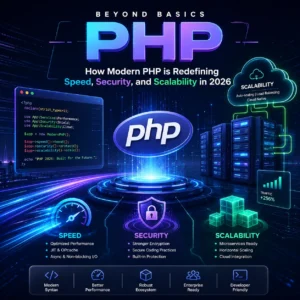
Speed is one of the most significant improvements in modern PHP. With enhancements in the core engine, PHP applications now execute faster and consume fewer resources. Features like opcode caching reduce the need for repeated compilation, resulting in quicker response times.
Developers can also leverage performance optimization techniques such as efficient database queries, caching mechanisms, and content delivery networks. These practices ensure that PHP applications deliver fast and seamless user experiences.
As a result, modern PHP can handle high-traffic environments without compromising performance.
Security is a critical aspect of web development, and modern PHP has made significant strides in this area. Built-in functions help prevent common vulnerabilities such as SQL injection and cross-site scripting.
Developers can use prepared statements, input validation, and secure authentication methods to enhance application security. Regular updates and community-driven improvements further strengthen PHP’s security framework.
By following best practices, developers can create applications that are resilient against potential threats.
Scalability is essential for applications that need to grow over time. Modern PHP supports scalable architectures, allowing applications to handle increasing user demands efficiently.
With support for distributed systems and cloud-based deployments, PHP applications can scale horizontally and vertically. Load balancing, caching strategies, and optimized server configurations further enhance scalability.
This makes PHP a strong choice for startups and enterprises looking to build high-performance applications.
In 2026, API-driven development is a standard practice, and PHP plays a crucial role in this space. Modern PHP frameworks enable developers to build robust APIs that integrate seamlessly with various platforms.
PHP’s compatibility with microservices architecture allows developers to break down applications into smaller, manageable components. This approach improves flexibility, maintainability, and scalability.
As businesses adopt cloud-native solutions, PHP continues to adapt and support modern architectural patterns.
The PHP ecosystem has grown significantly, offering a wide range of tools and frameworks. Popular frameworks provide structured environments for building applications efficiently.
Composer, the dependency manager for PHP, simplifies package management and integration. Testing tools, debugging utilities, and performance monitoring solutions further enhance the development process.
This rich ecosystem ensures that developers have everything they need to build high-quality applications.
Despite the emergence of new technologies, PHP remains a popular choice for businesses. Its cost-effectiveness, large talent pool, and extensive community support make it a reliable option.
PHP enables rapid development, allowing businesses to launch applications quickly. Its flexibility ensures that applications can be customized to meet specific requirements.
Additionally, PHP’s compatibility with various platforms and hosting environments makes it a versatile solution for businesses of all sizes.
To build future-ready applications, developers must follow best practices. Writing clean, modular code improves maintainability and reduces complexity.
Using modern frameworks, optimizing performance, and implementing strong security measures are essential. Regular updates and thorough testing ensure that applications remain stable and secure.
Developers should also focus on scalability and adaptability to meet future demands.
Modern PHP has successfully redefined itself as a powerful and reliable technology for web development. Its improvements in speed, security, and scalability make it a strong contender in today’s competitive landscape.
As businesses and developers continue to embrace digital transformation, PHP remains a valuable tool for building efficient and future-ready applications. With continuous innovation and community support, PHP is well-positioned to thrive in the years ahead.