Understand business needs objectives
Propose tech stack, timelines architecture
Sprint-based development with regular demos
Final testing and go-live with complete documentation
Ongoing maintenance, upgrades scale-up
Understand business needs objectives
Propose tech stack, timelines architecture
Sprint-based development with regular demos
Final testing and go-live with complete documentation
Ongoing maintenance, upgrades scale-up

We help define the ideal stack
Our architects suggest best options
With estimation, milestones & approach
Flexible delivery model: fixed or dedicated

Get expert tech consultation at no cost.
Get Free Tech AdviceBrief us on your needs (tech stack, duration, etc.)
Receive matched profiles within 24–48 hours
Interview the candidates and choose the right fit
Kick off the project seamlessly with our support

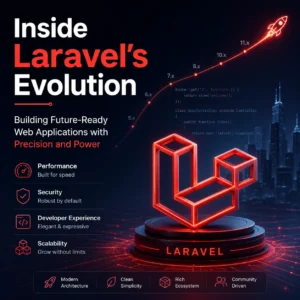
Laravel started as a simple PHP framework aimed at making development easier and more expressive. Over the years, it has transformed into a comprehensive ecosystem that supports complex applications and enterprise-level solutions. Each version has introduced improvements in performance, code structure, and developer experience.
What sets Laravel apart is its consistent focus on clean syntax and developer-friendly features. From routing to database management, Laravel simplifies complex tasks while maintaining flexibility. This evolution has made it a preferred choice for startups as well as large-scale enterprises.
Laravel’s strength lies in its rich set of features that streamline development. One of the most notable features is the MVC architecture, which ensures clear separation of logic and presentation. This leads to better code organization and maintainability.
Another important feature is Eloquent ORM, which allows developers to interact with databases using simple and expressive syntax. Laravel also offers Blade templating engine, making it easy to design dynamic user interfaces.
Built-in tools like task scheduling, queue management, and API support further enhance productivity. These features collectively make Laravel a robust framework for modern web development.
Future-ready applications require flexibility, adaptability, and the ability to integrate with emerging technologies. Laravel supports API-first development, enabling seamless integration with mobile apps, third-party services, and microservices architecture.
Laravel also works well with modern frontend frameworks, allowing developers to create highly interactive user experiences. Its compatibility with cloud platforms and containerization technologies ensures that applications can scale as business needs grow.
By supporting modern development practices, Laravel helps developers build applications that are not only relevant today but also prepared for tomorrow.
Performance is a critical factor for any web application. Laravel offers multiple tools and techniques to enhance speed and efficiency. Features like route caching, configuration caching, and optimized autoloading significantly improve application performance.
For scalability, Laravel supports distributed systems and load-balanced environments. Developers can use queue systems to handle background tasks efficiently, reducing server load and improving response time.
With proper implementation, Laravel applications can handle high traffic and large datasets without compromising performance.
Security is a major concern in web development, and Laravel addresses it with built-in protection mechanisms. It offers features like CSRF protection, SQL injection prevention, and secure authentication systems.
Laravel’s hashing and encryption services ensure that sensitive data remains protected. Additionally, its regular updates help developers stay ahead of potential vulnerabilities.
By following Laravel’s security best practices, developers can build applications that are safe and reliable.
Laravel is not just a framework; it is a complete ecosystem. Tools like Laravel Forge, Envoyer, and Vapor simplify deployment and server management. Laravel Nova provides an elegant admin panel for managing application data.
The ecosystem also includes packages for testing, debugging, and performance monitoring. These tools help developers streamline their workflow and focus on building high-quality applications.
The strong community support further enhances Laravel’s ecosystem, providing solutions, tutorials, and regular updates.
Businesses today need applications that are cost-effective, scalable, and easy to maintain. Laravel meets these requirements by offering rapid development capabilities and reusable components.
Its flexibility allows businesses to customize applications according to their needs. Additionally, Laravel reduces development time, leading to faster project delivery and lower costs.
The availability of skilled developers and extensive documentation makes Laravel a reliable choice for businesses across industries.
To maximize the benefits of Laravel, developers should follow best practices. Writing clean and modular code improves maintainability. Using built-in features instead of custom solutions ensures consistency and reduces errors.
Regular updates and proper testing are essential for maintaining application performance and security. Developers should also focus on optimizing database queries and minimizing unnecessary processes.
Adopting these practices helps in building efficient and future-ready Laravel applications.
Laravel has evolved into a powerful framework that simplifies web development while addressing modern challenges. Its rich features, strong ecosystem, and focus on performance and security make it an ideal choice for building future-ready applications.
As technology continues to evolve, Laravel remains at the forefront by adapting to new trends and requirements. Developers and businesses alike can rely on Laravel to create applications that are precise, scalable, and ready for the future.