Understand business needs objectives
Propose tech stack, timelines architecture
Sprint-based development with regular demos
Final testing and go-live with complete documentation
Ongoing maintenance, upgrades scale-up
Understand business needs objectives
Propose tech stack, timelines architecture
Sprint-based development with regular demos
Final testing and go-live with complete documentation
Ongoing maintenance, upgrades scale-up

We help define the ideal stack
Our architects suggest best options
With estimation, milestones & approach
Flexible delivery model: fixed or dedicated

Get expert tech consultation at no cost.
Get Free Tech AdviceBrief us on your needs (tech stack, duration, etc.)
Receive matched profiles within 24–48 hours
Interview the candidates and choose the right fit
Kick off the project seamlessly with our support

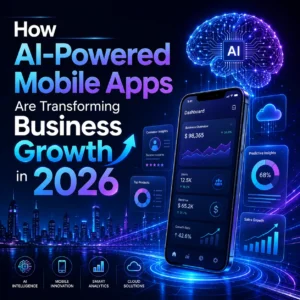
Artificial Intelligence (AI) is rapidly changing the way businesses operate in the digital world. In 2026, AI-powered mobile applications are becoming one of the most important tools for companies looking to improve customer engagement, automate operations, and increase overall business efficiency. From personalized recommendations to intelligent chatbots and predictive analytics, AI is helping businesses deliver smarter and faster digital experiences.
Modern consumers expect instant responses, seamless navigation, and personalized services. Traditional applications are no longer enough to meet these expectations. This is where AI-powered mobile apps are transforming business growth by providing intelligent solutions that improve user satisfaction and operational performance.
AI-powered mobile applications use technologies such as machine learning, natural language processing, predictive analytics, and automation to provide smart functionalities within mobile apps. These applications can analyze user behavior, understand customer preferences, and deliver customized experiences in real time.
Unlike traditional apps, AI-driven mobile applications continuously learn and improve based on user interactions. This allows businesses to make data-driven decisions and optimize their services more effectively.
Some common examples of AI features in mobile apps include:
Businesses across various industries are investing heavily in AI mobile app development because it offers long-term growth opportunities. AI technologies help companies improve productivity, reduce operational costs, and enhance customer experiences.
One major reason businesses are adopting AI-powered applications is automation. Many repetitive tasks such as appointment scheduling, customer inquiries, and order management can now be handled automatically through AI systems. This saves time and improves operational efficiency.
Another reason is customer engagement. AI applications can understand user behavior and provide personalized recommendations, helping businesses improve customer satisfaction and retention rates.
Improved Customer Experience
AI helps businesses provide personalized experiences based on user preferences and behavior. Customers receive relevant content, recommendations, and support, improving engagement and satisfaction.
Better Business Automation
AI automates repetitive processes such as customer support, inventory tracking, and payment processing. This helps businesses reduce manual work and improve productivity.
Enhanced Data Analysis
AI-powered apps can analyze large amounts of customer data and generate useful insights. Businesses can use this information to improve marketing strategies and make better business decisions.
Faster Customer Support
AI chatbots and virtual assistants provide instant customer responses 24/7. This improves response time and reduces dependency on manual customer support teams.
Increased Security
AI technologies such as biometric authentication and facial recognition improve app security and protect user data from cyber threats.
Many industries are already experiencing the benefits of AI-powered mobile applications.
Healthcare
Healthcare apps use AI for appointment scheduling, virtual consultations, patient monitoring, and medical record management.
Ecommerce
Online shopping platforms use AI for product recommendations, customer behavior analysis, and personalized marketing campaigns.
Finance
Banking and finance apps use AI for fraud detection, expense tracking, and customer support automation.
Education
Educational applications use AI for personalized learning experiences, virtual tutors, and smart assessments.
Logistics and Transportation
AI helps logistics companies optimize delivery routes, manage fleets, and improve operational efficiency.
AI-powered mobile applications are introducing several advanced features that improve user interaction and engagement.
Personalized Recommendations
AI analyzes user preferences and behavior to recommend products, services, or content based on individual interests.
Voice Search and Assistants
Voice-enabled AI systems allow users to interact with apps using voice commands, improving convenience and accessibility.
Predictive Analytics
AI can predict user behavior and future trends by analyzing historical data. This helps businesses improve decision-making and marketing strategies.
Smart Notifications
AI-powered notifications deliver relevant information to users at the right time, increasing engagement and conversion rates.
Customer support is one of the most important areas where AI is making a significant impact. AI chatbots can handle thousands of customer queries simultaneously, reducing wait times and improving customer satisfaction.
Automation also helps businesses improve efficiency by reducing human errors and streamlining workflows. Tasks such as data entry, scheduling, billing, and inventory management can now be managed automatically through AI systems.
This allows businesses to focus more on growth strategies and customer relationships instead of repetitive operational tasks.
In 2026, AI mobile app development is expected to become even more advanced. Businesses are likely to invest more in:
Companies that adopt these technologies early will gain a strong competitive advantage in the digital marketplace.